Venn Diagrams: Union, Intersection and Complements with Worked Examples
A Venn diagram shows membership of overlapping sets. The union contains items in either set or both; the intersection contains items in both. A complement contains the items outside a set but inside a specified universal set.
What will you learn?
- Distinguish union, intersection and only regions
- Avoid counting shared items twice
- Find complements relative to a stated universal set
What do union and intersection mean?
Write A union B, usually shown as A ∪ B, for everything in A, B, or both. Write A intersection B, shown as A ∩ B, for the shared items. The word or in a union includes the overlap; it does not mean exactly one of the sets.
A only contains members of A that are not in B. This is different from all of A, which includes the overlap. For counts, use union = count in A + count in B - count in both. Subtract the overlap once because the first two counts included it twice.
Why does a complement need a universal set?
The universal set U defines the items being considered. The complement of A contains the members of U that are not in A. Someone outside both circles can still belong to U, so a complete diagram often includes a surrounding rectangle.
Do not assume that a tool's two input lists describe the whole population. ChartMaker can work out shared and unique members from supplied lists, but the number in neither set requires additional information about U. The circles in these examples are schematic; their areas do not measure the counts.
Find shared and unique club members
The universal set is eight fictional pupils: Ada, Ben, Chen, Dina, Emil, Fatima, Gus and Hana. Set A, cycling, contains Ada, Ben, Chen and Dina. Set B, swimming, contains Ben, Dina and Emil.
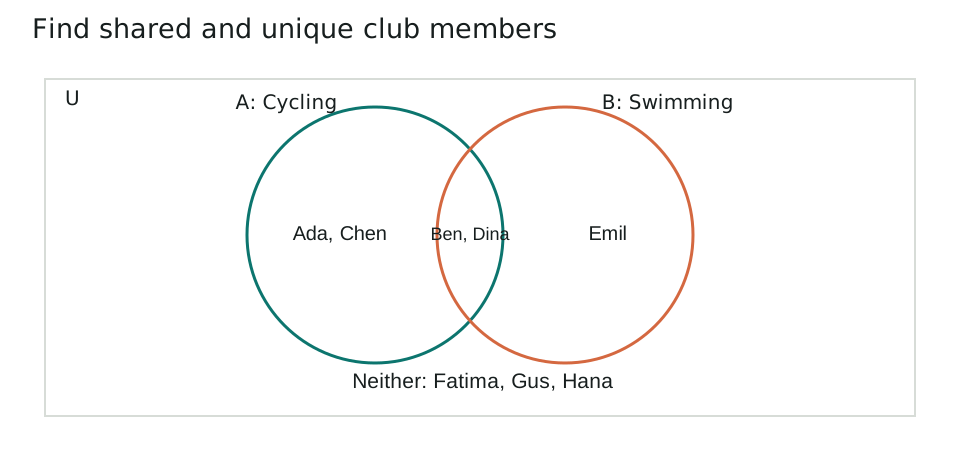
| Region | Members | Count |
|---|---|---|
| A only | Ada, Chen | 2 |
| Both A and B | Ben, Dina | 2 |
| B only | Emil | 1 |
| Neither | Fatima, Gus, Hana | 3 |
A has 4 members and B has 3. Their intersection has 2. The union is 4 + 3 - 2 = 5 distinct pupils. Adding the exclusive regions gives the same result: 2 + 2 + 1 = 5.
The complement of A within U contains Emil, Fatima, Gus and Hana, giving 4 pupils. The complement of the union contains the 3 pupils in neither club. These are different complements, so name the set you are complementing.
Use a numerical universal set
Let U be the whole numbers 1 through 10. Let A = {2, 4, 6, 8} and B = {3, 6, 9}. Items are set members, not repeated measurements.
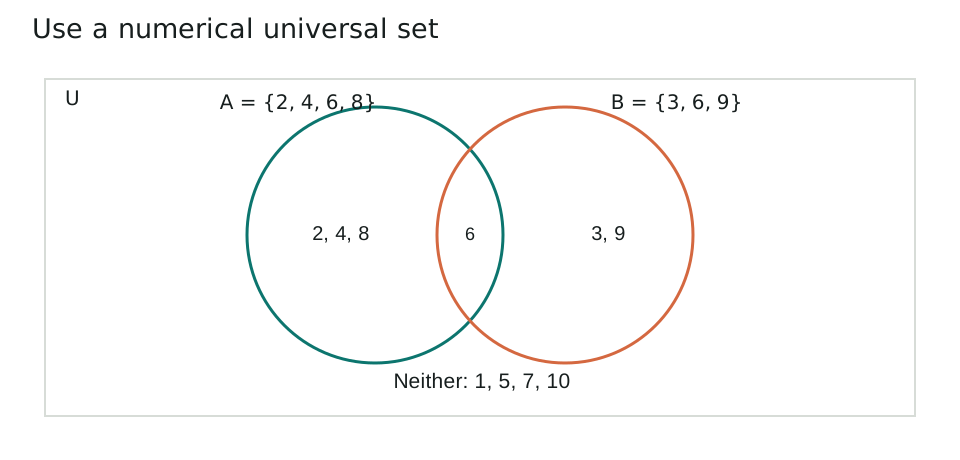
| Set or region | Members | Count |
|---|---|---|
| Intersection | 6 | 1 |
| Union | 2, 3, 4, 6, 8, 9 | 6 |
| Complement of A | 1, 3, 5, 7, 9, 10 | 6 |
| Neither A nor B | 1, 5, 7, 10 | 4 |
The only shared member is 6, so the intersection has size 1. The union has 4 + 3 - 1 = 6 members. The remaining 10 - 6 = 4 members of U belong to neither set.
A set lists each member only once. Entering 6 twice in A does not create a second distinct member and must not increase its count. Check the universe before saying that a number belongs to a complement.
Which mistakes should you avoid?
- Adding the two set totals without subtracting the shared members.
- Confusing A only with all members of A.
- Calculating a complement without defining the universal set.
Five practice questions
Use the worked examples above. Try the questions before opening the answers.
- Which pupils are in the intersection of cycling and swimming?
- How many pupils are in at least one of the two clubs? Show a calculation.
- List the complement of cycling within the eight-pupil universal set.
- For the number sets, list the union and state how many numbers are in neither set.
- If 6 is entered twice in the numerical set A, should the union count change? Explain.
Show answers and working
- Ben and Dina are in both lists, so the intersection contains 2 pupils.
- 4 + 3 - 2 = 5 pupils. Subtracting the overlap avoids counting Ben and Dina twice.
- Emil, Fatima, Gus and Hana. These four pupils are in U but not in cycling.
- The union is {2, 3, 4, 6, 8, 9}. It has 6 members, leaving 10 - 6 = 4 numbers in neither set.
- No. A set contains distinct members. Repeating 6 does not create an additional item or change membership of any region.
Common questions
Does union mean exactly one set?
No. A union includes items in either set and also items in their overlap. Exactly one set excludes the overlap.
Can a Venn diagram show an empty intersection?
Yes. If the sets share no members, the intersection is empty. In a schematic Venn diagram the overlap can remain drawn and be labelled zero.
Printable worksheet and teacher answers
The A4 worksheet contains the two examples, five practice questions with writing space, and a separate answer page. Print pages 1-2 for students and retain page 3 for marking. Suggested time: 30 minutes.
Download worksheet and answers (PDF)Free to print and share for classroom and home learning. All examples use original fictional data and contain no real pupil information.